
-
GET INSTANT & CUSTOMIZED WORKOUTS FOR YOU
Find the best workout for my lifestyle.
-
VIEW OUR EXTENSIVE EXERCISE DATABASE
Discover new exercises to try at the gym and at home.
- Muscular Strength Exercises
- Romanian Deadlift
- Cardio Workouts
- Leg Press Machine
- Jumping Jacks
- Sumo Deadlift
- Power Clean
- Sumo Squat
- Glute Bridge
- Bicycle Crunches
- Bent Over Barbell Row
- Inverted Row
- Close Grip Bench Press
- Dumbbell Squat
- Seated Cable Row
- Benefits of Exercise
- Muscle Anatomy
- Decline Bench Press
- Barbell Bench Press
FAQ
Pricing
Login


Free Calorie Meal Plans & Metabolic Science
Is Your Metabolism Slow or "Stuck"?
Take our 60-second audit to see if hormonal resistance is blocking your results.
Resting Heart Rate Chart: Your Targets and Healthy Pulse for Physical Activity
Resting Heart Rate Chart
Heart rate chart at rest: targets for exercise, your goals and a healthy pulse.
You can jump right to the heart rate (resting) charts by clicking on the different table link below.
Heart Rate Chart by Age (Resting) Heart Rate Chart Men (Resting) Heart Rate Chart Women (Resting)
What Is It?
What Is Heart Rate?
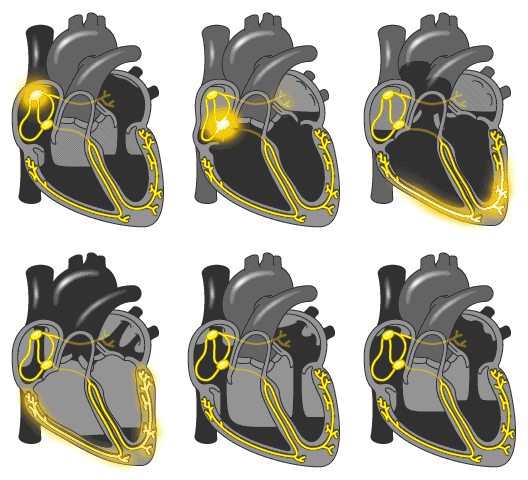
Heart rate is defined as the number of heart beats per unit of time, and this is normally expressed as beats per minute (bpm). This rate is based on contractions of the lower chambers of the heart (ventricles). These contractions vary depending on the body's need for oxygen, which occurs more during exercise or less while sleeping.
Measurement of the heart rate is done simply by finding one's pulse. This brings us to the next question. What is a pulse and how to find it?
Pulse
What Is a Pulse?
The pulse is felt due to the bulging of an artery when blood flows, causing a wave through the blood vessel. A pulse can be determined at various points of the body where an artery's pulsation is felt on the surface.
♥ The pulse is simply measured by pressing the index and middle finger on the artery.
♥ Some popular areas are: The neck, groin, behind the knee; the temple, over the abdomen, inside the elbow, or under the biceps and wrist.
♥ A more accurate method of determining pulse rate is by using an electrocardiograph.
Pulse Compared

Pulse and Heart Rate Compared
Is your pulse rate the same as your heart rate?
Yes, pulse and heart rate essentially mean the same thing and are frequently interchanged. Obviously, rates will vary from person to person and level of activity.
Normal Ranges
Normal Heart Rate at Rest
What is a normal pulse or normal resting heart rate?
Resting heart rate is the pulse rate when one is at rest or in a relaxed position. It's important in helping to determine any abnormalities.
The resting heart rate (HRrest) can also indicate a healthy heart rate.
♥ In adults, the typical resting heart rate is 60 - 80 bpm.
♥ If rates occur below 60 bpm, this is known as bradycardia, while rates over 100 bpm are known as tachycardia.
♥ Athletes usually have resting heart rates below 60 bpm due to hypertrophy of the heart.
A sample estimate of normal heart rate during rest at different ages is shown below.
| Category | Age Range | Beats Per Minute |
| Newborns | 0 - 30 days old | 70 - 190 |
| Infants | 1 - 11 months old | 80 - 120 |
| Children | 1 - 10 years old | 70 - 130 |
| Children + Adults | Over 10 years old | 60 - 100 |
| Well trained Athletes | Adult | 40 - 60 |
Normal heart rate ranges in women of different ages are as shown below in bpm.
| AGE | 18- 25 | 26-35 | 36-55 | 46-55 | 55-65 | 65+ |
| ATHLETE | 54-60 | 54-59 | 54-59 | 54-60 | 54-59 | 54-59 |
| VERY FIT | 61-65 | 60-64 | 60-64 | 61-65 | 60-64 | 60-64 |
| GOOD FITNESS | 66-69 | 65-68 | 65-69 | 66-69 | 65-68 | 65-68 |
| ABOVE AVERAGE | 70-73 | 69-72 | 70-73 | 70-73 | 69-73 | 69-72 |
| AVERAGE | 74-78 | 73-76 | 74-78 | 74-77 | 74-77 | 73-76 |
| UNFIT | 79-84 | 77-82 | 79-84 | 78-83 | 78-83 | 77-84 |
| POOR HEALTH | 85+ | 83+ | 85+ | 84+ | 84+ | 84+ |
Normal heart rate ranges in men of different ages are as shown below in bpm.
| AGE | 18- 25 | 26-35 | 36-55 | 46-55 | 55-65 | 65+ |
| ATHLETE | 49-55 | 49-54 | 50-56 | 50-57 | 51-56 | 50-55 |
| VERY FIT | 56-61 | 55-61 | 57-62 | 58-63 | 57-61 | 56-61 |
| GOOD FITNESS | 62-65 | 62-65 | 63-66 | 64-67 | 62-67 | 62-65 |
| ABOVE AVERAGE | 66-69 | 66-70 | 67-70 | 68-71 | 68-71 | 66-69 |
| AVERAGE | 70-73 | 71-74 | 71-75 | 72-76 | 72-75 | 70-73 |
| UNFIT | 74-81 | 75-81 | 76-82 | 77-83 | 76-81 | 74-79 |
| POOR HEALTH | 82+ | 82+ | 83+ | 84+ | 82+ | 80+ |
Your Pulse Count
To calculate one's pulse, the below formula is used:
♥ PULSE COUNT = # BEATS IN 10 SECONDS × 6 = # OF BEATS/MINUTE
Your Max Numbers
Maximum Heart Rate
The Maximum Heart Rate (HRmax) is the highest number of times (beats) one's heart can contract in a unit of time, usually one minute. HRmax is normally used to measure intensities during training and exercise.
How to Measure
How to Measure Max Rate
How to measure maximum heart rate? HRmax can be estimated using a formula. This can be an age-predicted maximum heart rate formula shown below, or it can also be measured during exercise. The most accurate way of measuring HRmax is via a cardiac stress test.
Fox and Haskell
- Formula Abbreviations
- HR = Heart Rate
- Max HR = Maximum Heart Rate
- HRmax = Maximum Heart Rate
- HRrest = Resting Heart Rate
- BPM = Beats Per Minute
- The Fox and Haskell Max Heart Rate Formula
- WOMEN: 226 - AGE OF PERSON = AGE-ADJUSTED HRmax
- MEN: 220 - AGE OF PERSON = AGE-ADJUSTED HRmax
- HRmax = Maximum Heart Rate
- HRrest = Resting Heart Rate
- BPM = Beats Per Minute
A woman of 40 years, her age-adjusted maximum heart rate is calculated as: 226 - 40 years = 186 bpm (beats per minute).
A 40-year-old man, his bpm will be calculated as shown: 220 - 40 years = 180 bpm (beats per minute).
- Other formulas that are often used
- HRmax = 206.3 - (0.711 × age)
- HRmax = 217 - (0.85 × age)
- HRmax = 208 - (0.7 × age)
Keep in mind, these estimates vary from person to person depending on one's genetics and exercise level. For example, when a person starts an exercise plan, their heart adjusts accordingly. When one becomes more fit, the heart also becomes more efficient in pumping blood to the rest of the body.
Help Me
The Best Meal Plan App
Using the latest science and research, the team at changingshape.com offers plans developed by certified nutrition and fitness professionals. Join the changingshape.com calorie counter app free today.
Research Corner
📚 Coaching Delivers 4.73 lbs MORE Weight Loss
Research proves that combining coaching with app-based programs results in significantly greater weight loss than apps alone.
"You Can't Outrun a Bad Diet"
90% of obesity is driven by diet, not lack of movement. Your body has a "Metabolic Thermostat." When you exercise more, it burns less energy elsewhere to keep you stable.
This Plan is Generic. You Need Specific.
This sample menu works for an "average" person. But you aren't average. Your hormonal profile, weight history, and activity level require exact macro targets to work.
Get your personalized plan + 1-on-1 coaching to adjust it as you progress.
GET MY CUSTOM PLAN (SAVE $400)Normal Weight Ranges for Women
Healthy Weight Averages for Men
Body Fat Percentage Chart
Target Heart Rate Definition
Target Heart Rate Formula
Target Heart Rate Calculator
What Is My Resting Metabolic Rate?
When paired with a human coach.